 |
 |
 |
 |
 |
 |
 |
 |
 |
 |
 |
 |
 |
 |

|
Currently there are no events or updates to display. |

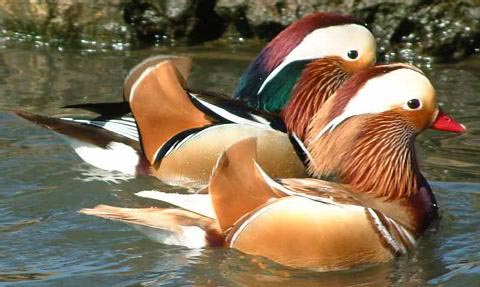
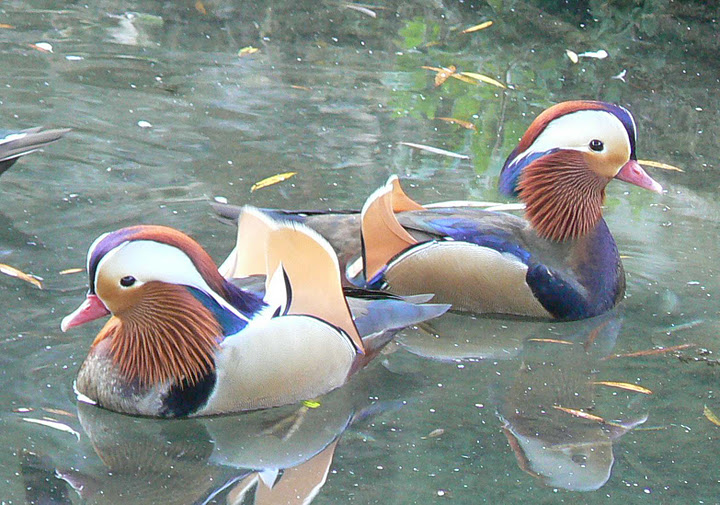
The Mandarin - the Answer to the Urban Duck Keeper's Prayers For many of us presently raising waterfowl and for many more of us who would like to do so, the reality of zoning laws in urban and suburban areas makes doing so somewhere between difficult and impossible. Even in small towns more and more restrictions are being placed on the keeping of "poultry" in town". As a result, many people keep birds under the constant threat of sanction by local government. All it takes is a complaint by a single neighbor in many cases. Why might a neighbor complain? It could be the noise caused by quacking Call ducks, the disturbance of sleep caused by the crowing of roosters, the smell caused by less than sanitary pens (too many birds, pens too small), or even that "barnyard" birds do not belong in a suburban neighborhood. Of course, there are many things that could and should be done to reduce such objections: visually screening the birds from the neighbors; providing attractive and well-landscaped buildings and pens; seeing to it that noise was kept to a minimum, etc. Sometimes such measures work and sometimes they don’t. The answer to those who would like to keep some sort of waterfowl may simply be to choose carefully the type one keeps. There is a bird available that possesses virtually every quality one could ask of such fowl. It is small (and thus easily kept in a relatively small area), it is quiet (its array of soft whistles and other noises is neither loud nor unpleasant to the ear), and it is one of the most beautiful and ornamental birds in the entire world. You want more? O.K., how about that it is fairly easy to obtain, relatively inexpensive, can be raised on feed products commonly available, and it requires no federal or state license to keep it. I am speaking, of course, of the Mandarin Duck. A close relative of our North American Wood Duck, (they are the only two members of the genus Aix, the Mandarin being Aix galericulata and the Wood Duck being Aix sponsa). The Wood Duck is exclusively native to North America while the Mandarin is native to China, Japan, and Russia, where relatively small wild populations survive to the present day under government protection. By some estimates, the combined wild populations may not exceed 20,000 birds.
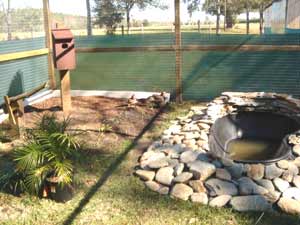
This pen at Acorn Hollow is part of one of the gardens. It is fully screened and the top is corrugated fiberglass to allow for maximum light.
The Mandarin was known and revered in Asia well before the birth of Christ. Westerners were quick to discover them when they began to visit those areas of the world and captive Mandarins were brought to Europe as early as the 1700's. Construction of Display Pens The construction of penning for Mandarins should emphasize security for the birds and ease of maintenance for the keeper. Any pen should, therefore, be at least 6 feet in height. The lowest 18 inches of the wire should be no larger than ½ inch by ½ inch to prevent predators from reaching into the pen. The use of treated or Cedar posts and other pieces touching the ground is recommended. Wire that is galvanized after welding will resist rust for a much longer period of time. If a pond of any kind is planned, be sure to take into consideration how it will be cleaned. A drain is best but a hose used as a siphon will work satisfactorily. A pond that is easily cleaned will most likely be cleaned more often. If a rubberized liner is employed, get a thick one and allow a good amount of it to form a rim around the outer edge. Leaks are a pain to fix, to say the least. It is much easier to prevent them than to repair them. Breeding the Mandarin The majority of Mandarin breeders seem to prefer to maintain their birds in full winged form which means that the birds are fully capable of flight and must be managed accordingly. When birds are full flighted, their nest boxes may be at ground level or raised to head height for easier management. Some breeders prefer to pinion or wing clip their birds either because they allow them out of fully covered pens or to reduce the risk of loss through escape. In such cases, nest boxes must be located on or near the ground with some sort of a ramp provided. The presence of plantings such as ornamental grasses, small ornamental trees (Japanese Maples are good), and herbaceous perennials (be sure that neither fruit nor any other part of the plant is toxic) not only makes the birds happier but greatly enhances the ornamental value of the pen. I would recommend that the pen be no smaller than 10 ft. X 10 ft. for one or two pairs. Two other things that should definitely be included in the layout of such a pen is a pool for swimming, and tree limbs, stumps or rocks (or all three) that will allow the Mandies to perch above the ground a few feet. Of course, if the birds are pinioned, the height of such objects should be adjusted accordingly. In some of the more elaborate Mandarin pens I have seen, the swimming area includes a small waterfall which greatly enhances the beauty of the scene and eliminates the possibility that the water will be still enough to allow mosquitoes to breed in the pond. In cold climates, it might be a good idea to at least partially cover the pen sides with plastic in the winter to cut down on the effects of wind on both plants and birds. I have found that if the plastic sheeting is to hold up to winter winds here in the Midwest, the thicker the plastic is the better. I use 6 Mil for my own pens. I do not supply any supplementary heat. Many breeders I spoke with prefer to keep a mating together over a period of years once it proves to be successful in producing good quality offspring on a consistent basis. In the event that is desirable to change a mating, it can be done most easily if the former mates are not able to see one another. I have found no documented longevity records available for Mandarins but I have repeatedly gotten reports that individuals have lived and reproduced for at least 8-10 years. One recent report from another breeder claimed a pair that not only lived but was productive for 20 years! If accurate, that would be the rare exception and not the norm. Pierre Terran of France bands all of his pairs and reports that birds which reproduce for 10 years or perhaps less are typical in his flock.
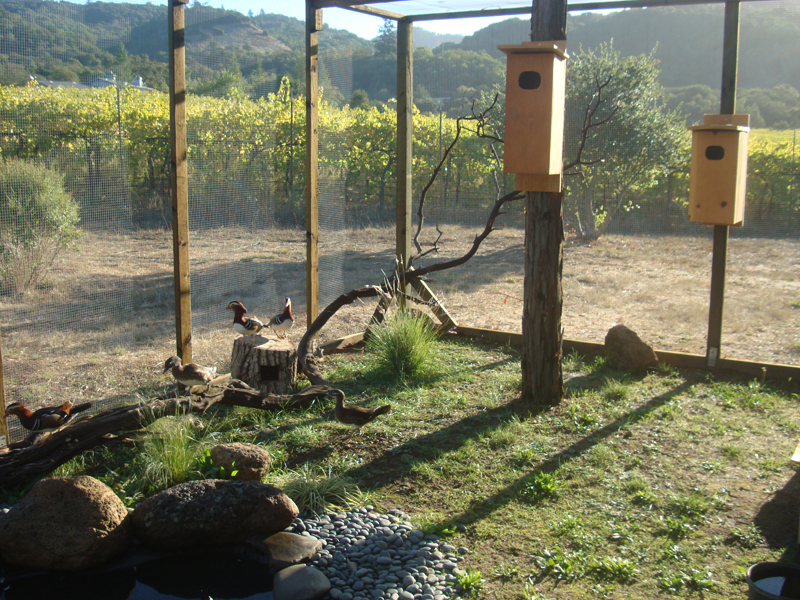
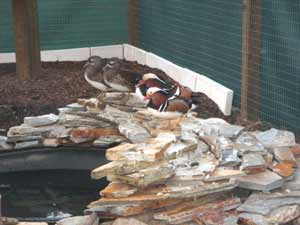
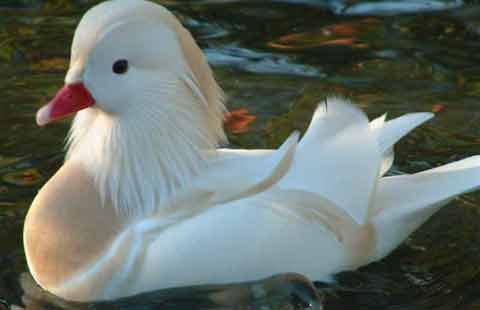
This beautiful flight enclosure for some Acorn Hollow Mandarins features a pond and many perching spots that Mandarins love. It is located in California. A second view of the enclosure shows some of several nest boxes in the pen as well as some of the native plants. Mandarin Mutations Mandarin mutations are of great interest to many raisers but at this time, only one of the several possible mutations is easily obtainable in this country. That one is the White. When a Normal is crossed with a White, the males that result from the mating are called splits which means that they carry the recessive gene for white even though they may appear to be normal in coloration. The females cannot carry the recessive gene and so are capable of producing only the color they themselves are unless mated to a split male. Other mutations are also considered recessive and those include the Apricot (or Blonde), and the black. It is believed that those mutations (along with White) occur in nature but that those birds usually do not survive for long because of their different coloration makes them stand out to predators. In Europe, the Apricot, Black, White, and even Buff mutations exist and can be found in private collections. Unfortunately, importation restrictions have made it impossible to bring those colors to the U.S. as of now. I believe, however, that it is not only possible but probable that we will see more mutations occur in our U.S. and Canadian flocks of Mandarins in the upcoming years.
While Mandarins are generally considered to have a wild temperment, they are rather easily tamed. Andrew Markham photo
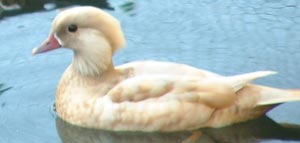
Perhaps the most common reason for poor results when raising Mandarins is the use of breeding stock that is too inbred (too closely related). For that reason, it may be a good practice to go to more than one breeder to obtain stock after inquiring about the origins of their lines of birds. This Apricot Mandarin female is typical of the color pattern. There will be some variation in the pattern from one bird to the next, however. Photo by Pierre Terran Because the Mandarin is a cavity nest builder, some form of nest box must be provided. There are a number of styles that have been used successfully by breeders. Most of the differences have to do with the depth of the box and the type of lid that must be present for cleaning and management. See the related article on Mandarin nest boxes. The statements that appear below are the consensus obtained from my conversations with several experienced Mandarin breeders. Wherever possible, I include the two mutations presently known in Mandarins in the U.S., the white and the apricot where differences in behavior or management are noted. Either keep the colors separately or only pen them together at times other than the breeding season if you do not wish the colors to cross.
Breeder management Mandarins are almost universally bred in pairs, although sometimes a male will mate with a second female after his original mate has begun incubating a clutch of eggs. Most clutches amount to 8-12 eggs although yearling females and white females may lay slightly smaller clutches. A second or third clutch may be obtained by removing the eggs as they are laid and incubating them artificially. That practice has two major drawbacks, however. Most breeders report superior hatches when the Mandarin females are allowed to incubate their own eggs, either the entire 28 days or up until, say, the 26th day after which the eggs are moved to an incubator to complete the hatch. One hundred percent hatch of fertile eggs is quite common using that second method. The other drawback is that forcing second or even third clutches during a breeding season almost certainly shortens the female’s life. Fertility is usually very good when well matured and genetically strong (not too inbred) birds are involved. Fertility among second-year males is sometimes much improved over their first season. Of course, part of the equation is that the breeders are fed a well-balanced waterfowl or gamebird breeder ration. A breeder ration should contain 16% protein at a minimum with 20% preferred. In the event that game bird and other specialty feeds are not available, supplementing with Calf Manna or Animax works. The availability of clean swimming water is also a must. Multiple pairs can be housed together as long as the pen is large enough to permit each pair to claim some space of their own. Housing several pairs together may, however, increase the likelihood that several females will all lay in one nest. Such use of a single nest box by multiple females is often called “dump nesting”.
Two pairs of Acorn Hollow Mandarins at their new home at customer Bob Lee's place in Florida
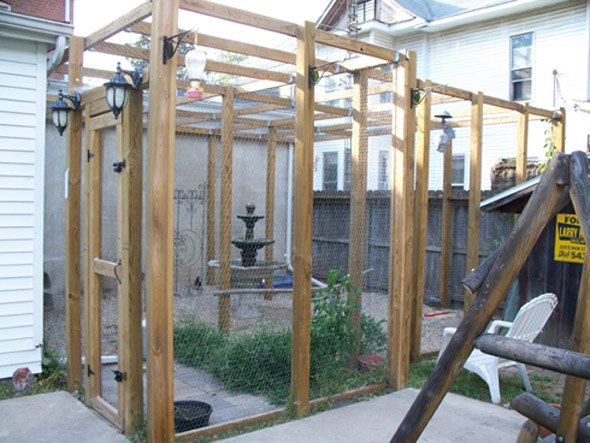 Another customer built this facility in downstate Illinois which is quite suitable for two pairs of Mandarins.
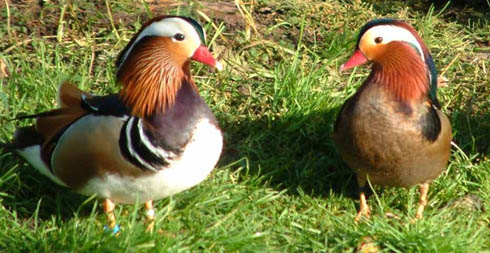 Another mutation is the Black Mandarin which is on the right in this photo. Pierre Terran photo
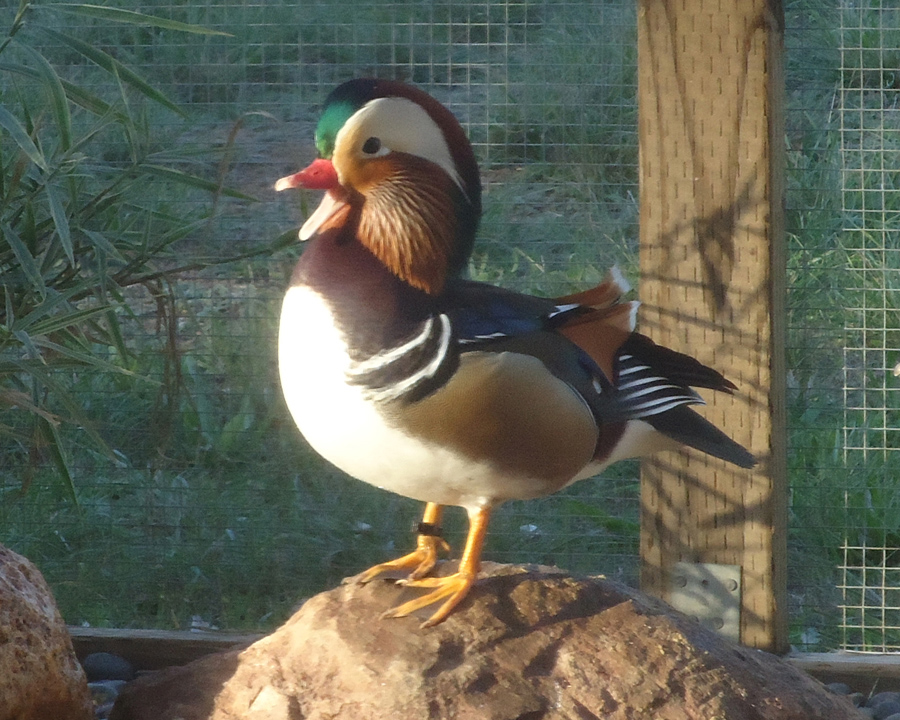
This Acorn Hollow Mandarin drake seems happy in his new home. Males usually take 4-6 weeks to come into full color in the fall. Feeding Your Mandarins One piece of really good news about the Mandarin is that in spite of its exotic appearance, it does well on an easily obtained array of foods. Mandarins can be maintained during times other than the breeding season on any quality duck grower pellet in the 16%- 18% protein range supplemented with some whole grains such as wheat and oats. A plus would be access to grass but many breeders do very well without access to pasture. for a special treat, they really enjoy Meal Worms which can be fed live or dried. Meal Worms contain 53 % animal protein. During the breeding season, the use of a high quality gamebird breeder or waterfowl breeder is recommended. Don’t forget to provide the breeders with oyster shell during the breeder season but remove it at other times of the year as continued ingestion of the calcium source can cause organ damage. Feeding of ducklings is where there is a great deal of difference in practices. Most breeders feed ducklings a good quality duck starter/grower but some supplement that (especially with very young ducklings) with finely chopped egg yolks live Meal Worms, (actually the larvae of a beetle) etc. Sprinkling the hard boiled egg yolks on the backs of newly hatched ducklings may stimulate their instinct to feed, which is critical particularly with white ducklings. Also, including some domestic bantam ducklings hatched about the same time can be helpful since they can teach the Mandies to eat. Once the ducklings are a few days old, sprinkling finely chopped fresh grass clippings into very shallow water pans can be beneficial but be sure that the ducklings do not get soaked as soaking can be fatal. Put such pans on the wire bottomed brooders at first only when someone can be close by to watch how the ducklings react. Keep the ducklings on the starter/grower for 4-6 weeks until they are well feathered and then gradually switch them over to grower pellets. Whether one is dealing with adult stock or growing ducklings, it cannot be stressed too much that Mandarins require clean drinking and bathing water. The failure to provide that will result in poorly conditioned, unhealthy birds. They will drink less and will bathe less frequently in dirty water.
Black Mandarins on water- Pierre Terran photo This is a new mutation which Pierre has developed in France.
Odds and Ends The majority of those who successfully keep and breed Mandarins keep their birds full winged. Most who do so believe that doing so promotes the optimum breeding situation for their birds. There are very successful breeders, however, who breed from pinioned or wing clipped birds for a variety of reasons. It seems a matter of personal choice. While Mandarins are really quite cold hardy even in Midwestern winters, they must be afforded protection from the wind and should be provided with bedding that will allow them to rest off of the damp ground. Good straw works for that purpose as well or better than anything else. I often use clean pine shavings also. Some breeders prefer to employ a “wet brooder” rather than a conventional one because they believe that the availability of swimming water stimulates better feathering and superior overall health of the growing ducklings. Simply put, a wet brooder contains a shallow container for swimming embedded in the floor of the brooder so that the birds can enter it easily. Be sure to provide a hardware cloth ramp out of the water so that there is no chance that the little guys will fail to figure out how to get out of the water. Mandarin mutations - There is a growing number of Mandarin color mutations other than the White. The Apricot and Buff are just two that I have seen in person. Unfortunately, they are available only in Europe at present. Virtually all the information given here can be applied to the Wood Duck, sometimes referred to as the Carolina Duck. Be reminded, however, that the Wood Duck is a native specie in North America and as such is subject to state and federal regulation and licensing.
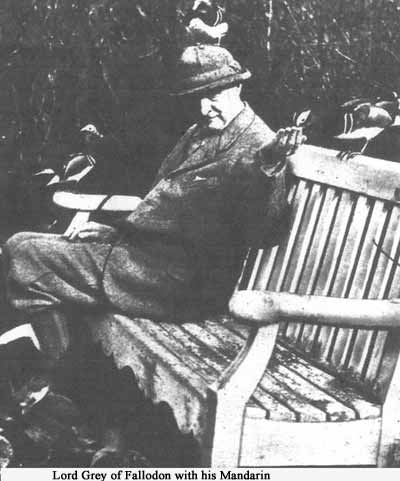
Lord Grey established one of the first wild flocks of Mandarins in the UK. Here he is shown feeding some of them out of his hand. This gentleman was one of the original sponsors of wild Mandarins in the UK This photo was taken around 1820 at his estate in Fallodon, which is located in the northeast portion of England. The photo demonstrates how tame even feral Mandarins can become. Acknowledgements I wish to acknowledge and thank the following Mandarin breeders who contributed information and, in some cases, some great pictures to this article:
Good books on the subject Very little has been written specifically on the Mandarin and much of what is available deals primarily with their historical background and place as a subject of fine art. The first book listed below has some wonderful photographs. The Wood Duck and the Mandarin by Shurtleff and Savage University of California Press (1996) The Mandarin Duck By Christopher Lever Published in Britain by C. I. Thomas & Sons (1990) The Mandarin Duck by Christopher Savage Black Publishing of London (1952) Last updated: 01-19-2021 |

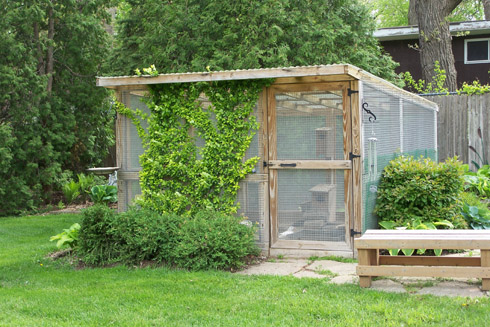
 By the 1800's, there was at least one resident wild flock of Mandarins thriving in the UK and there is presently at least one feral flock of Mandies in residence in the western U.S. that coexists well with the local population of Wood Ducks. There are also wild flocks in Germany and in Ireland. In case you are wondering whether such closely related species as the Mandarin and Wood Duck will cross, the answer is yes and no. They will freely mate with one another but the eggs from such unions are almost always infertile. Reports exist of hybrids but usually turn out to be pure but poor specimens of one or the other specie that just look like crosses. Interestingly enough, there are numerous verified reports of successful crosses with other species of ducks. I have witnessed, for example, the willingness of Mandarins to mate with domestic Calls. The scene to the right is the Mandarin pen at Bill Wulff's home in Connersville, Indiana.
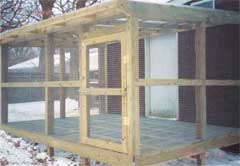 The top should ideally consist of welded wire or some sort of translucent roofing material. The use of game bird netting may well result in an invasion by predators capable of tearing through it. To totally eliminate the possibility of animals digging under and into the pen, bury welded wire several inches below the base material which should be 3-4 inches of sand or pea gravel to encourage good drainage. The pen in the photo to the left has been built on a raised platform which eliminates threats from digging predators and also allows water and manure to pass through. Generally speaking, the larger a pen is, the better it is. Be sure to provide for some cover inside the pen to allow the birds some measure of privacy. Be careful not to use any toxic plants such as Japanese Yews. Dwarf Junipers work well as do some other forms of dwarf conifers. If in doubt, contact the local Extension Office to check out plant toxicity.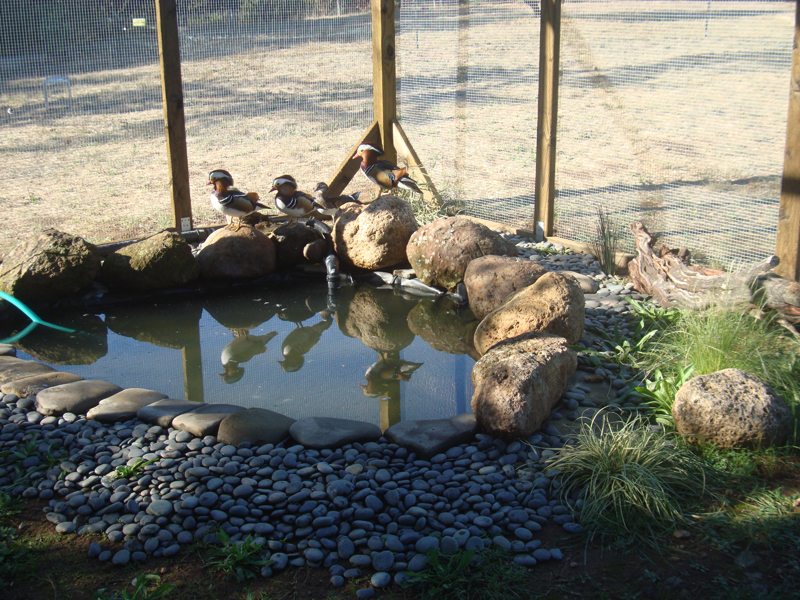


Copyright © 1997 - 2026 Acorn Hollow Bantams. All Rights Reserved. | Terms of Use | Privacy Policy